How the Internet Was Built: From Four Computers to a Global Network
A selective history of the breakthroughs that turned experimental packet switching into the infrastructure connecting billions of people and devices, while distinguishing the Internet from the World Wide Web.
Most people experience the Internet as something that simply exists, a background utility as constant as electricity. It was not designed as one finished system. It grew from a single successful test between two computers in 1969 into a layered set of agreements, protocols, naming systems and governance bodies that different institutions built, argued over and gradually connected across five decades.
This timeline follows that layered construction: the packet switching that let separate machines exchange data at all, the addressing and naming conventions that let millions of independent networks recognize one another as a single network, and the World Wide Web that later gave the underlying Internet a way to present information to ordinary users rather than only specialists.
The Internet and the Web are often used interchangeably, but they are distinct: the Internet is the global network of interconnected networks, while the Web is one application, among many, that runs on top of it. Understanding that distinction, and the sequence of technical decisions behind it, explains why the network still works the way it does today, and where its current limits, such as an unfinished transition to IPv6, come from.
-
Breakthrough
ARPANET sends its first host-to-host message
A message travelled from UCLA to the Stanford Research Institute over the experimental packet-switched ARPANET.
Before this test, separate computer labs had no shared way to exchange data beyond dedicated point-to-point lines built for a single purpose. A UCLA student attempted to log into a Stanford Research Institute computer over the new ARPANET; the system crashed after only the letters L and O arrived, making "LO" the accidental first message ever sent across a packet-switched network. Engineers restored the connection within the hour and completed the login. The exchange mattered because it showed that Interface Message Processors, the specialized routing computers ARPANET used to move data in small packets, could carry a real interactive session between two physically separate machines rather than only laboratory test traffic. That proof pushed ARPANET from a funded research proposal toward a working four-node network that expanded through the 1970s.
Sources & references 2 sources
-
Application
Networked email introduces the user@host address
Ray Tomlinson adapted messaging to cross between computers and selected @ to separate a user from a host.
Before this, messaging systems let users leave notes only for other accounts on the same shared computer, with no way to address someone on a different machine. Ray Tomlinson adapted an existing local mail program to also work across ARPANET's separate host computers, and picked the @ symbol, chosen mainly because it rarely appeared in names, to separate a user from the specific host holding their mailbox. The user@host format he introduced set the addressing pattern every Internet mail system has used since, turning the network from a tool for remote computing sessions into a channel for everyday communication between institutions.
Sources & references 2 sources
-
Standard
TCP describes a network of networks
Vint Cerf and Bob Kahn published a design for connecting different packet networks through a common protocol.
By the early 1970s several separate packet networks existed, including ARPANET, radio-based networks and satellite links, but each used incompatible internal formats with no common way to talk to one another. Vint Cerf and Bob Kahn published a design describing gateway computers that could sit between different networks and translate their packets using a single shared protocol, without requiring every network to change its own internal technology. That gateway concept, refined over the following years into TCP and the separate IP, established the core principle that later let ARPANET, university networks and eventually millions of unrelated networks interconnect as one Internet rather than remaining isolated islands.
Sources & references 2 sources
-
Standard
ARPANET switches to TCP/IP
ARPANET hosts replaced the older NCP protocol with TCP/IP, creating a shared foundation for internetworking.
Through the late 1970s ARPANET ran on NCP, an older protocol built for a single homogeneous network and unable to route traffic between separate networks. On 1 January 1983 every host on ARPANET switched over to TCP/IP at once, a coordinated cutover engineers nicknamed flag day because there was no way to run both protocols side by side during a gradual transition; hosts that were not ready lost connectivity until they upgraded. The switch mattered because it replaced a protocol tied to one specific network with one designed from the start to connect many independent networks, turning ARPANET into the technical backbone of what could now genuinely be called an internetwork.
Sources & references 2 sources
-
Infrastructure
DNS makes the Internet easier to navigate
The Domain Name System replaced an increasingly unmanageable central host list with a distributed hierarchy of memorable names.
Until the mid-1980s every host on the network was identified through a single master list of names and addresses, maintained centrally and copied out to individual machines, an approach that grew unworkable as the number of connected computers climbed into the thousands. The Domain Name System replaced that flat file with a distributed, hierarchical naming structure, letting different organizations manage their own portion of the namespace while computers still resolved a memorable name into the correct numeric address automatically. That change removed a centralized bottleneck that would otherwise have limited how many networks and machines could practically join, and it is the same hierarchical structure still used to look up every domain name today.
Sources & references 2 sources
-
Expansion
NSFNET becomes a research backbone
The U.S. National Science Foundation launched NSFNET to link researchers and supercomputing centres, rapidly broadening access.
ARPANET connected mainly a limited set of defense-related research sites, leaving most university researchers without practical access to the network or to the supercomputing centres the U.S. National Science Foundation had begun funding. NSFNET linked those supercomputing centres together and let regional campus networks connect in, using TCP/IP as its foundation, and it grew far faster than ARPANET because far more universities could justify the connection. Within a few years NSFNET's regional and backbone links carried more traffic than ARPANET itself, effectively becoming the network's new core and setting up the eventual retirement of the original ARPANET backbone in 1990.
Sources & references 1 source
-
Invention
Tim Berners-Lee proposes the World Wide Web
At CERN, Tim Berners-Lee proposed a hypertext system for linking and sharing information across computers.
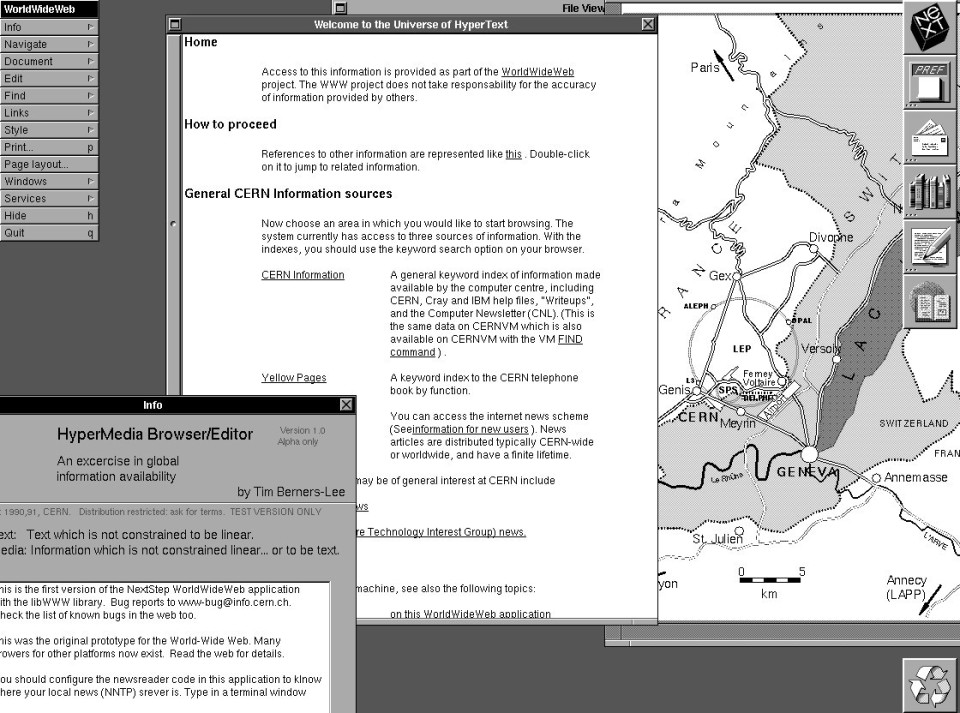
CERN By the late 1980s the Internet could move data between networks efficiently, but sharing documents across different computer systems at CERN still meant dealing with incompatible file formats and no common way to link one document to another. Tim Berners-Lee proposed a system combining hypertext, documents containing clickable links to other documents, with the Internet's existing networking, so that information stored on different machines could be connected and browsed without everyone using the same hardware or software. The proposal defined the ideas that became HTML, HTTP and the URL, giving the existing Internet infrastructure a simple way to present and connect information for ordinary users rather than only specialists moving files by hand.
Sources & references 1 source
Continue reading
-
Launch
The first website opens the Web to Internet users
The first public website explained the Web project and showed how to create servers, browsers and pages.
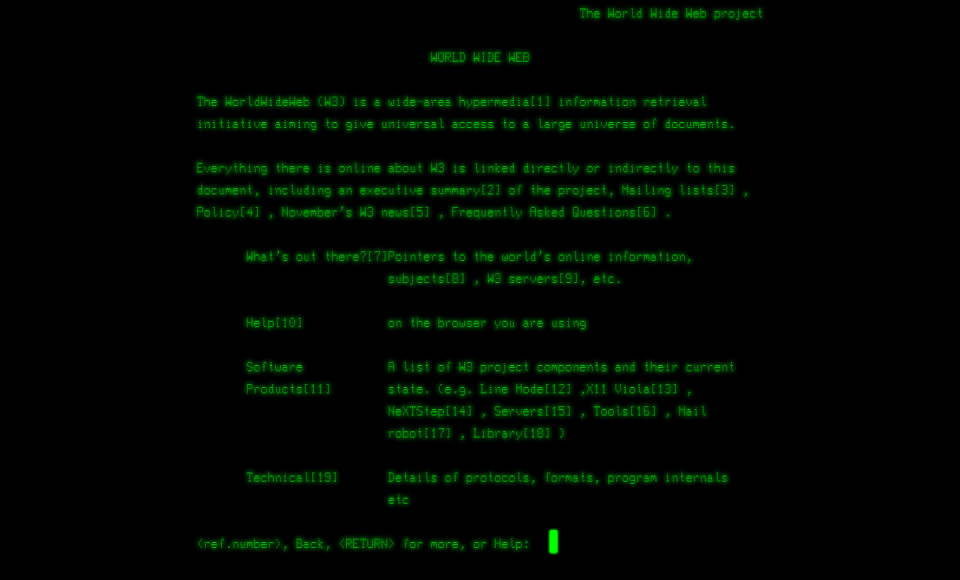
CERN (CDS) Berners-Lee's proposal had described a system in principle, but until mid-1991 there was no publicly reachable place demonstrating it in practice or explaining how someone outside CERN could build their own server or browser. The first public website, hosted on a NeXT computer at CERN, published the Web project itself, its background, the technical specifications for HTTP and HTML and instructions for setting up a server. Making the explanation of the technology available through the technology itself let outside physics labs and, soon after, other institutions begin running their own servers and browsers, moving the Web from an internal CERN tool toward a system other organizations could adopt independently.
Sources & references 1 source
-
Product
Mosaic gives the Web a visual, approachable interface
NCSA Mosaic helped popularise graphical Web browsing and made pages approachable to a wider audience.
Early Web browsers displayed pages mainly as text, and using them still required enough technical familiarity that the Web remained largely a tool for researchers rather than the general public. NCSA Mosaic added inline images alongside text and a simple point-and-click interface that ran on ordinary desktop computers, making pages look and behave more like the visual documents people already expected from print and software. Because Mosaic was free and reasonably easy to install, it spread quickly through universities and then homes, and is widely credited with turning the Web from a niche research tool into something non-specialists actually wanted to use, setting up the commercial browser market that followed.
Sources & references 2 sources
-
Policy
CERN releases Web software into the public domain
CERN made the core Web software freely available, removing a licensing barrier to implementation and expansion.
Even after Mosaic's success, CERN technically still held the underlying rights to the core Web software, and outside organizations building their own servers or browsers faced uncertainty about what licensing terms might eventually apply. CERN's directors placed the World Wide Web software, its source code, into the public domain, removing any royalty or licensing barrier to implementing it. That decision meant any company, university or individual could build Web servers and browsers without negotiating rights with CERN, a precondition that let the rapid browser and server competition of the mid-1990s happen without a single gatekeeper controlling who could build for the Web.
Sources & references 1 source
-
Commercialisation
The Internet backbone shifts toward commercial service
NSF retired NSFNET’s backbone as commercial providers took over general connectivity in the United States.
Through the early 1990s, the main U.S. Internet backbone was still NSFNET, a network funded by the National Science Foundation primarily for research and education, with restrictions on the general commercial traffic it could carry. NSF retired the NSFNET backbone and shifted general connectivity onto backbones operated by commercial Internet service providers, ending federal operation of the network's central U.S. infrastructure. The transition let ordinary businesses and consumers connect without routing through a research-funded backbone, and it is the shift that made the mid-to-late 1990s commercial Internet, and the dot-com era that followed, structurally possible.
-
Governance
ICANN is formed to coordinate Internet identifiers
ICANN was created to coordinate naming and numbering functions needed for one interoperable global Internet.
Through the 1990s, functions such as assigning domain names, IP address blocks and protocol parameters had been handled informally, largely through IANA under a single individual's stewardship and U.S. government contracts, an arrangement that did not scale as the Internet became commercially and internationally significant. ICANN was created as a nonprofit organization to formally coordinate these naming and numbering functions, with a board and processes intended to represent a broader international community of technical and commercial stakeholders rather than one government or one person. Centralizing this coordination in a dedicated institution let the same domain name and address system keep working consistently as the number of registrars, registries and countries involved multiplied.
Sources & references 2 sources
-
Infrastructure
IANA Allocates the Last Free IPv4 Address Blocks
On 3 February 2011, IANA allocated its remaining five /8 blocks of IPv4 addresses, one to each Regional Internet Registry, emptying the global free pool of new IPv4 space for the first time in the protocol's history. The moment gave registries and providers a clear signal that future growth would depend on IPv6, adding urgency to the coordinated push that culminated the following year in World IPv6 Launch.
IPv4, the addressing scheme underlying the Internet since the 1980s, provides roughly 4.3 billion unique addresses, a number that seemed enormous when the protocol was designed but became visibly insufficient as billions of new devices, phones and always-on connections joined the network. On 3 February 2011, IANA allocated its last five available address blocks, one to each Regional Internet Registry, emptying the central free pool for the first time in the protocol's history; individual registries continued issuing from their own remaining stock for some years after. The depletion turned IPv6 adoption from a long-discussed future option into an operational necessity, since no further IPv4 space could be created to meet growing demand, setting up the coordinated push that culminated the following year in World IPv6 Launch.
-
Infrastructure
World IPv6 Launch makes the next Internet protocol permanent
Major networks, websites and equipment makers permanently enabled IPv6 to expand address capacity beyond IPv4.
After 2011's address depletion, IPv6 existed as a finished standard offering a vastly larger address space, but many major websites and networks still ran it only as an optional, temporary test rather than a permanent default, leaving adoption fragmented. On 6 June 2012, major websites, home networking equipment vendors and Internet service providers permanently enabled IPv6 alongside IPv4 rather than switching it on and off for isolated trials, coordinated as World IPv6 Launch. Making IPv6 a permanent, default part of ordinary Internet traffic rather than an occasional experiment gave device makers, network operators and other websites a durable target to build toward, starting the slow, multi-decade transition whose progress is now tracked through metrics like the ratio of IPv6 to IPv4 traffic.
-
Milestone
IPv6 Traffic Reaches Parity With IPv4 For the First Time
On 28 March 2026, Google recorded IPv6 traffic reaching 50.1 percent of its measured global user connections, the first time the newer protocol carried more than half of that traffic since its 1998 standardization. The milestone did not hold; usage settled back into the mid to high 40s in the following months, and adoption remains highly uneven, from over 70 percent in France and India to under 20 percent across much of Africa, Central Asia and Southern Europe.
Following the 2012 launch, IPv6 adoption grew steadily but unevenly for over a decade, with some countries and networks approaching full deployment while others still relied almost entirely on IPv4. On 28 March 2026, Google recorded IPv6 traffic reaching 50.1 percent of its measured global user connections, the first time the newer protocol carried more than half of that traffic since its 1998 standardization. The milestone did not hold; usage settled back into the mid-to-high 40s in the following months, and the gap between leading countries, over 70 percent adoption in France and India, and lagging regions, under 20 percent across much of Africa, Central Asia and Southern Europe, shows that reaching this symbolic threshold once did not mean the transition begun in 2012 was complete.
Sources & references 2 sources
What comes next?
The Internet Is Not the Web
Many people use "the Internet" and "the Web" as synonyms, but the timeline above shows they are different layers built two decades apart. The Internet is the underlying network of networks, the addressing, routing and naming systems established between 1969 and 1984 that let independent networks exchange data at all. The World Wide Web, proposed in 1989, is one application built on top of that existing network, a system of linked documents accessed through browsers. Email, file transfer and countless other applications also run over the same underlying Internet without being the Web at all.
An Invisible Layer Under Everyday Systems
The protocols and naming systems in this timeline rarely surface to the people who depend on them. Every time a banking app, a streaming service or a connected car exchanges data, it relies on TCP/IP for basic transport and DNS to find the right server, without users ever encountering either by name. That invisibility is a sign of success rather than neglect: a coordination system spanning nearly every country and organization on Earth generally has to work silently to keep working at all.
An Unfinished Transition
IPv4 depletion in 2011 made IPv6 adoption operationally necessary, and 2026 brought the first moment IPv6 carried a slight majority of Google's measured global traffic. That threshold did not hold, and adoption remains highly uneven between countries. The practical trajectory is not a dramatic future event but a slow, uneven continuation of the same transition that began with World IPv6 Launch in 2012, expected to keep narrowing the gap between early adopting countries and regions still running almost entirely on the older protocol.
