From Brain Signals to Digital Speech: The Evolution of Brain-Computer Interfaces
How scientists learned to record, decode and translate neural activity into control, movement and communication, and why dependable daily use remains harder than a laboratory record.
What a Brain-Computer Interface Actually Does
A brain-computer interface records a pattern of neural activity, estimates what that pattern represents, and converts the estimate into an action outside the nervous system. Depending on the system, that action may move a cursor, control a robotic arm, select letters or synthesize speech. The interface does not extract a complete stream of thought. It learns signals associated with a defined task, such as attempting to move a hand or trying to pronounce a word.
The Trade-Off That Shapes the Field
Signals measured outside the skull avoid surgery but are weaker, noisier and less precise about where activity originates. Electrodes placed on or inside the brain capture richer signals, but require an operation and introduce questions about safety, durability and maintenance. Much of the field's history is an attempt to improve one side of this trade-off without making the other unacceptable.
From Detecting Electricity to Restoring Independence
The milestones below follow three connected advances: learning to measure the brain, teaching computers to decode intention, and making the resulting control useful to a person. The frontier is no longer a laboratory demonstration alone. It is whether an interface can remain accurate, safe and genuinely helpful through years of daily life.
-
Discovery
Electrical Activity Is Recorded From the Brain
Richard Caton detected changing electrical currents on the exposed brains of animals, establishing that brain activity produced measurable signals.
Caton's galvanometer measurements did not create a computer interface, but they supplied its essential premise: neural activity leaves an electrical trace that instruments can detect. The recordings required direct access to the brain and revealed little about how particular intentions were encoded.
Sources & references 1 source
-
Discovery
The First Human EEG Makes Brain Signals Non-Invasive
Hans Berger recorded electrical activity from a human brain, creating electroencephalography as a practical window into neural rhythms.
EEG moved brain recording from exposed animal cortex to electrodes placed on or near the human scalp. Its signals were safe and repeatable but spatially coarse, creating a tradeoff that still shapes non-invasive brain-computer interfaces.
Sources & references 1 source
Continue reading
-
Concept
The Brain-Computer Interface Becomes a Defined Research Field
Jacques Vidal framed direct brain-computer communication as an engineering problem and introduced the term brain-computer interface.
Vidal asked whether measurable brain signals could carry information to a computer quickly enough for real-time control. This changed the question from observing the brain to building a closed system that records a signal, decodes it and produces an external action.
Sources & references 2 sources
Continue reading
-
Demonstration
An Implanted Array Gives a Paralysed Person Continuous Cursor Control
BrainGate showed that movement intentions could be decoded from motor-cortex neurons years after paralysis and converted into real-time computer control.
A 100-electrode sensor recorded neural spikes from the motor cortex and translated them into cursor and device commands. The result demonstrated high-bandwidth intracortical control in a human, but the experimental system required surgery, cables, calibration and technical support.
-
Demonstration
Brain Signals Control a Robotic Arm in Three Dimensions
Two people with tetraplegia used implanted interfaces to reach for and grasp objects, moving BCI control from a screen into the physical world.
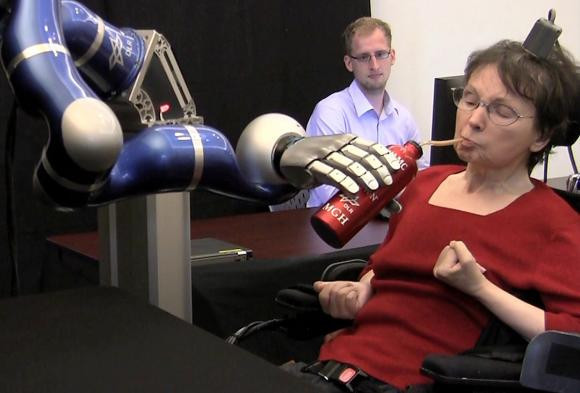
BrainGate collaboration / Brown University One participant used the robotic arm to lift a bottle and drink, an activity she had not performed independently for nearly 15 years. The experiment showed that motor-cortex signals remained useful long after injury, while also exposing the gap between a supervised laboratory demonstration and an autonomous home device.
-
Research
Imagined Handwriting Becomes Fast Text
A participant with paralysis produced text at 90 characters per minute by imagining handwriting while an intracortical decoder recognized the neural patterns.
Earlier cursor keyboards required selecting letters one at a time. Decoding the complex motion of an imagined pen produced faster communication and showed that richer attempted movements could be easier for algorithms to distinguish. The study involved one participant and remained dependent on implanted electrodes and individualized training.
Sources & references 1 source
Continue reading
-
Research
Attempted Speech Is Decoded Directly Into Words
A speech neuroprosthesis decoded attempted speech from cortical activity into sentences, bypassing muscles that paralysis had disconnected from voluntary control.
Instead of spelling through cursor movement, the system recognized neural activity associated with trying to say whole words. Its vocabulary and speed were still limited, and the decoder was trained around one participant, but the result established a direct path from attempted speech to text.
Sources & references 1 source
Continue reading
-
Demonstration
A Brain Implant Restores Text, Voice and Facial Expression
A system decoded attempted speech at nearly 80 words per minute and animated a digital avatar with synthesized voice and facial movements.
The demonstration expanded the goal from transmitting words to restoring the social signals carried by voice and facial expression. Accuracy was not perfect, the participant remained connected to research hardware, and clinical usefulness would require reliable operation across time and settings.
Sources & references 1 source
-
Clinical Research
Long-Term Use Becomes the Test of a Useful Interface
A participant with ALS used an implanted speech interface for thousands of hours, shifting attention from one-off performance records to durability and daily independence.
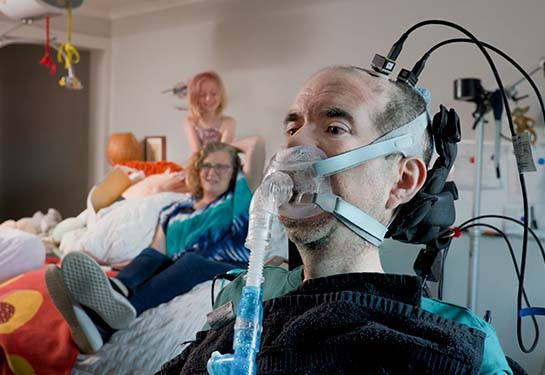
NewTqnia Laboratory speed alone does not make a medical device useful. Extended use tests signal stability, recalibration, hardware reliability, caregiver burden and whether communication remains meaningful in ordinary life. Current systems are still investigational, surgery carries risk, and broad clinical access will require regulatory evidence and support infrastructure.
Sources & references 1 source
Continue reading
-
Research
AI Improves Non-Invasive Brain-to-Text, but Does Not Read Free Thoughts
Brain2Qwerty decoded typed sentences from non-invasive brain recordings under a constrained task, illustrating both the promise and the boundary of modern neural decoding.
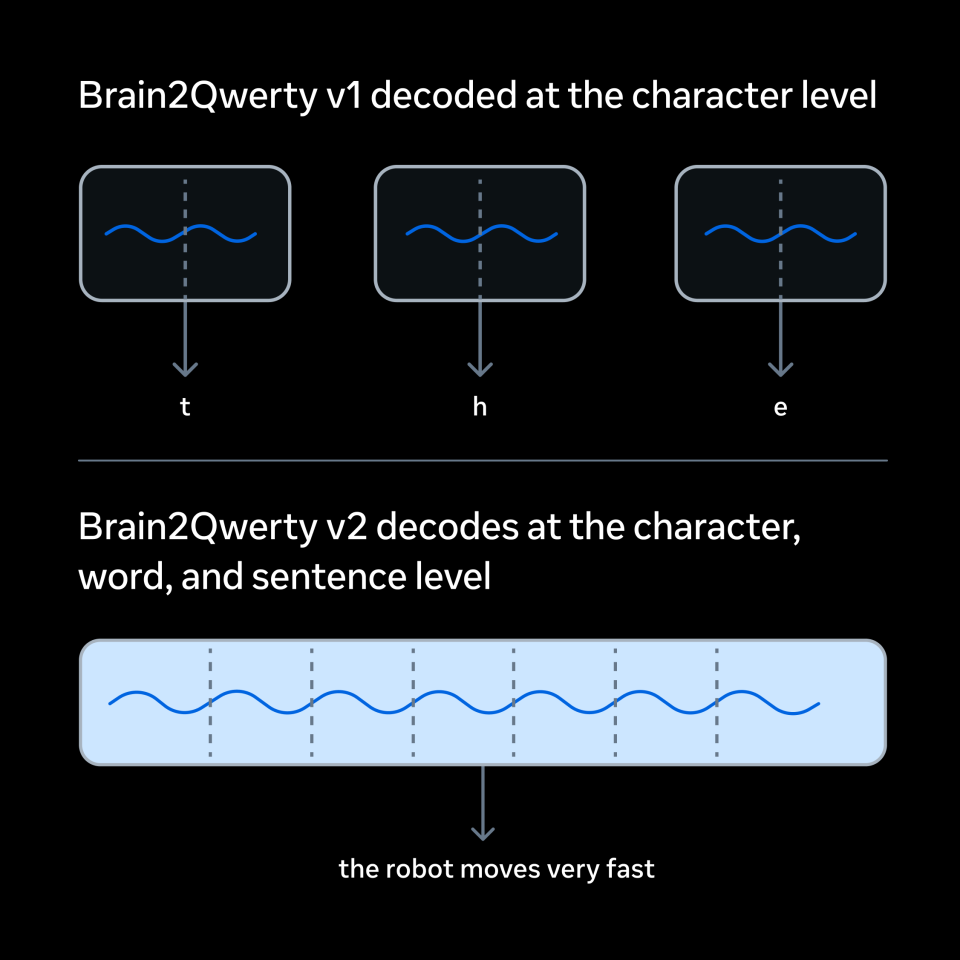
NewTqnia Machine learning can extract task-linked patterns from weak signals measured outside the skull, avoiding surgical implantation. The system did not recover unrestricted private thoughts: it relied on participants performing a known typing task, specialized equipment and language-model constraints. Non-invasive convenience still trades away signal detail and portability.
Sources & references 1 source
Continue reading
What comes next?
Reading Brain Activity Is Not Reading Minds
Every successful system in this timeline relied on a constrained task, training data and a decoder built around particular signals. Attempted handwriting, attempted speech and deliberate cursor control produce patterns an algorithm can learn. That is fundamentally different from recovering any private idea a person happens to have.
Invasive and Non-Invasive Systems Solve Different Problems
An implanted array may capture individual or small populations of neurons with enough detail for rapid control. EEG, MEG and other external methods avoid surgery but combine activity from larger areas and are more vulnerable to noise and movement. Better AI can improve decoding, but it cannot create information that the sensor never recorded.
The Hard Problem Is Long-Term Use
A record set during one laboratory session does not establish a useful medical device. Clinical value depends on signal stability, recalibration, wireless operation, hardware reliability, infection risk, caregiver workload and whether the system works when the user is tired, ill or outside a research centre.
Who Controls Neural Data?
Brain recordings can reveal health and task-related information even when they do not expose unrestricted thoughts. Future systems will need clear rules for consent, storage, secondary use, security, software updates and what happens if a manufacturer stops supporting an implanted device.
What Comes Next?
The most credible path is not a universal mind reader. It is a set of narrower assistive systems designed with users to restore communication, computer access or movement. Progress will be measured less by a single speed record and more by independent daily use, durable benefit and access beyond a small number of experimental participants.