The Road to Useful Quantum Computing: From Qubits to Error Correction
A living timeline of the theories, experiments and engineering milestones behind the effort to build quantum computers that solve useful problems beyond the reach of classical machines.
Quantum computers do not make every calculation faster. They manipulate quantum states to accelerate particular classes of problems, while noise and fragile qubits severely limit current machines. This timeline follows the path from foundational algorithms to cloud access, experimental quantum advantage, modular processors and error correction. Qubit count is not treated as a stand-alone measure of quality because fidelity, connectivity, circuit depth and logical error rates are equally important.
-
Theory
Richard Feynman argues for simulating nature with quantum machines
Feynman argued that classical computers struggle to simulate quantum physics and proposed computers governed by quantum rules.
The proposal did not supply a complete computer design, but it clarified a foundational motivation: a quantum system may efficiently model another quantum system. Quantum simulation remains one of the field’s most promising application areas.
Sources & references 1 source
-
Theory
David Deutsch defines a universal quantum computer
Deutsch formalised a quantum version of a universal computing machine and showed that quantum computation could be described systematically.
The work moved quantum computing from a simulation idea toward a general computational model. It established that quantum gates and circuits could in principle express arbitrary quantum computations.
-
Algorithm
Shor’s algorithm reveals a transformative quantum advantage
Peter Shor devised a quantum algorithm for factoring large integers efficiently, threatening widely used public-key cryptography in principle.
Shor’s algorithm gave the field a concrete high-impact application and made fault-tolerant quantum computing strategically important. Existing machines remain far too small and noisy to factor cryptographically relevant keys, but migration to quantum-resistant cryptography takes many years.
Sources & references 1 source
-
Research
Quantum error correction challenges the fragility problem
Researchers showed that quantum information could be protected without directly copying an unknown quantum state.
Error-correcting codes distribute one logical qubit across multiple physical qubits so errors can be detected and corrected. The cost is substantial overhead, but fault tolerance is the central route toward long computations that survive noise.
-
Experiment
A small experiment factors 15 with Shor’s algorithm
An IBM-led team implemented a simplified form of Shor’s algorithm using a seven-qubit nuclear magnetic resonance system.
Factoring 15 was not computationally useful, and the experimental platform was not scalable in its demonstrated form. Its value was symbolic and technical: an influential quantum algorithm had moved from paper into a controlled physical experiment.
Sources & references 1 source
-
Commercialisation
D-Wave sells a commercial quantum annealing system
Lockheed Martin bought a D-Wave One system built around a 128-qubit quantum annealing processor.
Quantum annealing targets optimisation problems and differs from a universal gate-based quantum computer. The sale was commercially important, but claims of speed advantage remained debated and qubit counts could not be compared directly with gate-model systems.
-
Access
IBM puts a quantum processor on the cloud
IBM Quantum Experience allowed researchers, students and developers to run circuits on real quantum hardware remotely.
Cloud access lowered the barrier to experimentation and helped build a developer ecosystem around quantum programming. Users still worked with small noisy devices, but quantum hardware was no longer confined to the laboratory teams that built it.
Sources & references 1 source
-
Experiment
Google claims experimental quantum advantage with Sycamore
Google’s 53-qubit processor performed a specialised random-circuit sampling task much faster than the classical estimate used by the team.
The experiment showed control of a programmable quantum processor beyond the team’s classical comparison for one contrived task. IBM disputed the original classical-runtime estimate, and the calculation had no direct commercial use. It was a laboratory milestone, not general quantum superiority.
-
Engineering
IBM prioritises quality and modular systems with Heron
IBM unveiled its Heron processor and Quantum System Two architecture, emphasising lower error rates and modular expansion.
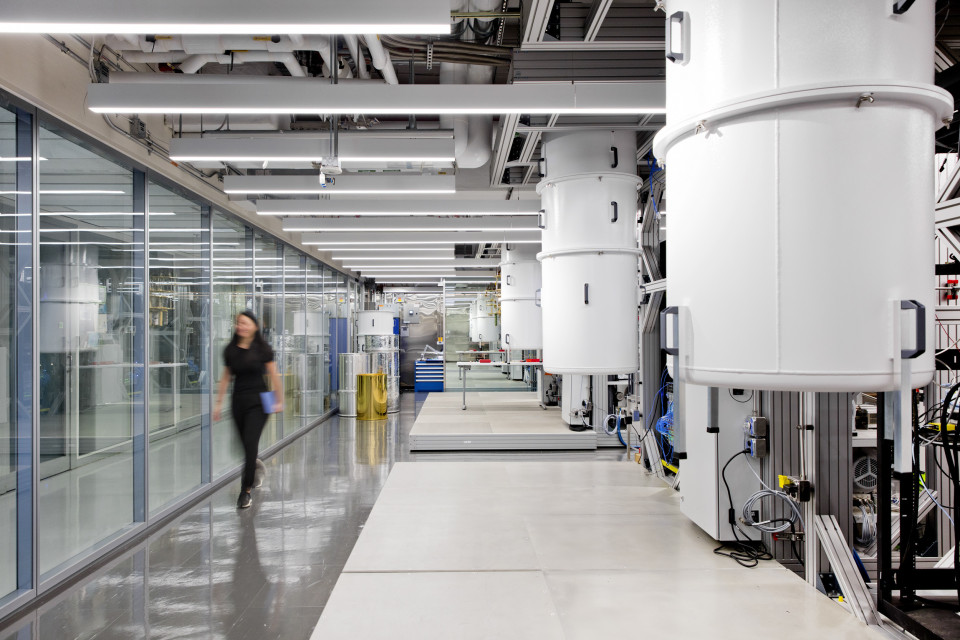
Connie Zhou for IBM The announcement reflected a shift away from celebrating qubit count alone. Useful circuits require qubits that remain coherent, perform accurate gates and can be connected through a scalable architecture. Company-defined “quantum utility” still did not equal fault-tolerant general advantage.
Sources & references 1 source
-
Security
NIST finalises the first post-quantum cryptography standards
Three standards provided encryption and digital-signature algorithms designed to resist future quantum attacks.
Post-quantum cryptography runs on conventional computers; it does not require a quantum machine. Standardisation acknowledged that cryptographic migration must begin before a sufficiently powerful quantum computer exists because replacing security infrastructure can take many years.
Sources & references 1 source
-
Breakthrough
Google’s Willow crosses an error-correction threshold
Google reported that increasing the size of its surface code reduced the logical error rate, a key requirement for scalable fault tolerance.
Below-threshold error correction means adding properly controlled physical qubits can improve a logical qubit rather than make it worse. The result was a major engineering step, but one improved logical memory is still far from the many reliable logical qubits and operations needed for broad applications.
What comes next?
The field has advanced from proving that quantum computation is possible to engineering machines that can control, connect and correct increasing numbers of qubits. A broadly useful fault-tolerant quantum computer has not yet been demonstrated. Progress now depends on reducing logical errors and showing economically meaningful applications, while governments and companies must migrate cryptography before a machine capable of breaking present public-key systems exists.