SpaceX and the New Commercial Space Race: From Falcon 1 to Starship
A living timeline of how SpaceX, NASA partnerships and reusable rockets reshaped launch economics, cargo delivery, human spaceflight, satellite internet and the ambitions of the commercial space industry.
SpaceX did not create commercial spaceflight alone. Its rise depended on public contracts, NASA technical oversight, launch infrastructure, suppliers and decades of earlier aerospace research. It nevertheless changed the industry by repeatedly flying privately developed orbital vehicles and pursuing aggressive reusability. This timeline separates demonstrated milestones from future ambitions and treats failures as part of development rather than proof of either inevitable success or inevitable collapse.
-
Company
SpaceX is founded around lower-cost access to orbit
Elon Musk founded Space Exploration Technologies with the long-term goal of reducing launch costs and enabling missions to Mars.
The company entered a sector dominated by governments and established aerospace contractors. Its strategy combined vertical integration, iterative testing and development of its own engines and launch vehicles. Founding ambitions were broad; operational credibility still had to be earned through flight.
Sources & references 1 source
-
Public Private Partnership
NASA backs commercial cargo development
NASA selected SpaceX and Rocketplane Kistler for funded demonstrations under the Commercial Orbital Transportation Services programme.
COTS used milestone-based public-private agreements rather than a traditional government-owned vehicle programme. NASA funding, expertise and the promise of later cargo contracts gave SpaceX a crucial customer and validation while leaving the company responsible for developing its system.
Sources & references 1 source
-
Launch
Falcon 1 becomes the first privately developed liquid-fuel rocket to reach orbit
After three failed attempts, Falcon 1 successfully placed the RatSat payload into low-Earth orbit.
The fourth flight established that the small company could design, build and operate an orbital launcher. The preceding failures nearly exhausted its resources and became central to SpaceX’s culture of rapid iteration, although later vehicles were substantially different designs.
Sources & references 1 source
-
Demonstration
Dragon returns safely after orbiting Earth
The first COTS demonstration flight sent Dragon to orbit and recovered it after re-entry.
The mission demonstrated the Falcon 9 and Dragon combination central to NASA cargo plans. Recovering a privately developed orbital capsule was a major step toward routine commercial delivery and later human spaceflight.
Sources & references 1 source
-
Space Station
Dragon becomes the first commercial spacecraft to visit the ISS
Astronauts aboard the International Space Station captured Dragon after its rendezvous with the orbiting laboratory.
The demonstration completed a central COTS objective and paved the way for operational cargo missions. The achievement was commercial, but it relied on NASA requirements, communications, station operations and public investment.
Sources & references 2 sources
-
Reusability
Falcon 9 lands an orbital-class first stage
After delivering 11 satellites, the first stage returned to Cape Canaveral and landed upright.
The landing did not by itself prove economic reuse, but it solved a central guidance and propulsion challenge. Earlier vehicles had achieved forms of vertical landing, while SpaceX’s distinction was recovering the first stage of an orbital-class mission.
Sources & references 1 source
-
Reusability
A recovered Falcon 9 booster flies again
The SES-10 mission reused an orbital-class first stage and landed it again after launch.
Reflight moved reusability from landing demonstrations toward an operational business model. Savings depend on refurbishment, inspection, launch cadence and mission requirements, so the cost effect cannot be inferred from reuse alone.
Sources & references 1 source
-
Launch
Falcon Heavy expands commercial heavy-lift capability
Three Falcon 9-derived cores launched together on the rocket’s demonstration mission, with two side boosters landing successfully.
Falcon Heavy offered greater payload capacity without developing every component from scratch. Its dramatic debut demonstrated modular reuse of proven hardware, although mission demand and certification determine how often heavy-lift capacity is actually used.
Sources & references 1 source
-
Satellite Network
Starlink begins deploying an operational satellite constellation
A Falcon 9 launched 60 Starlink satellites, beginning large-scale deployment of SpaceX’s broadband network.
Starlink created recurring internal demand for launches and extended SpaceX from transport into communications services. It expanded connectivity in underserved and disrupted regions, while raising concerns about astronomy, orbital congestion, debris and the power of a private network operator.
-
Human Spaceflight
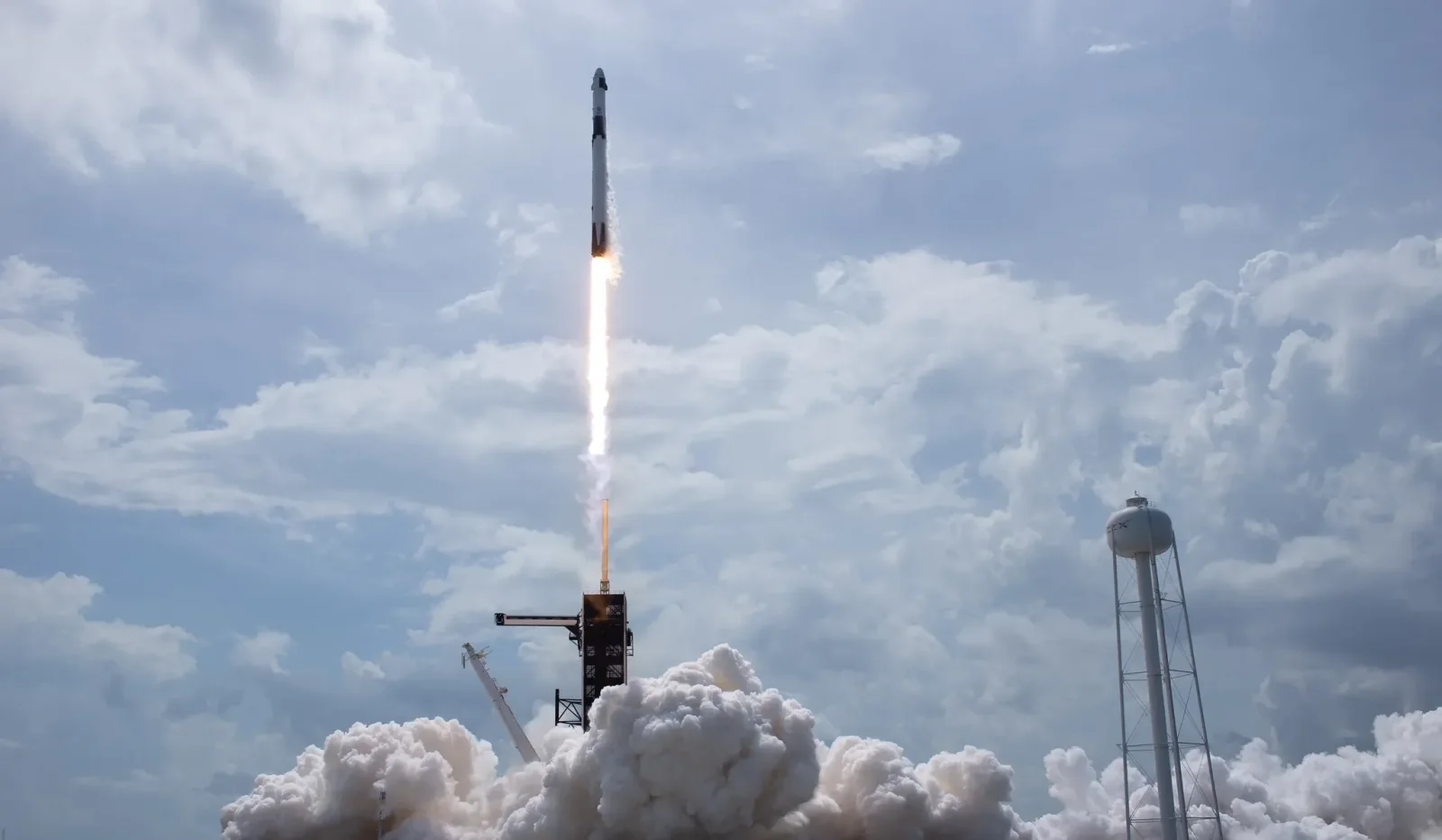
Crew Dragon carries astronauts to orbit
NASA astronauts Bob Behnken and Doug Hurley launched on Demo-2, the first crewed orbital flight by a commercially built and operated spacecraft.
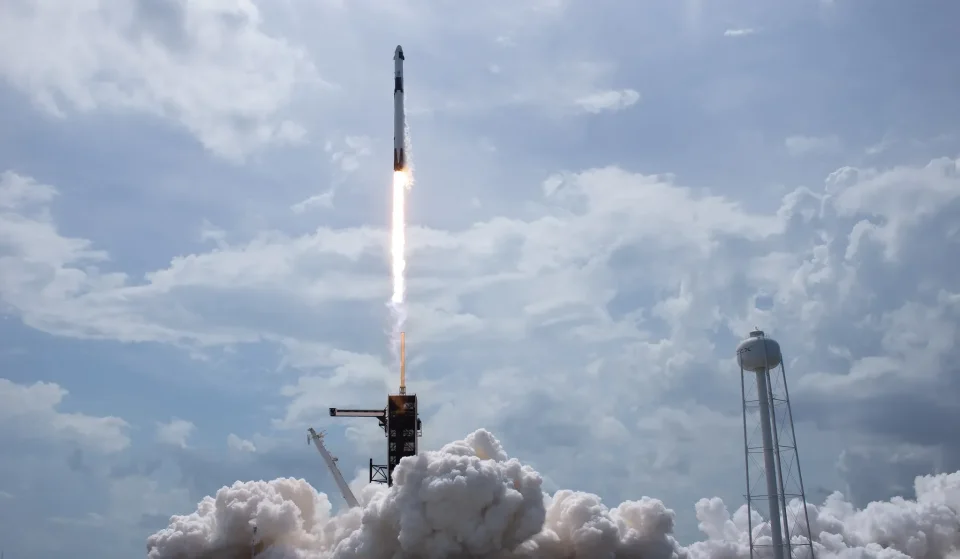
NASA/Bill Ingalls Demo-2 restored human orbital launches from the United States after the Space Shuttle’s retirement and validated the system ahead of regular crew rotations. NASA later certified Falcon 9 and Crew Dragon as the first commercial human spaceflight system for operational missions.
-
Human Spaceflight
Inspiration4 sends an all-civilian crew into orbit
Four private citizens flew on Crew Dragon without a professional astronaut onboard and spent three days in orbit.
The privately funded mission expanded the market beyond government astronaut transport and suborbital tourism. It demonstrated autonomous crew operations, but orbital private flight remained extremely expensive and dependent on mature government-developed safety infrastructure.
Sources & references 1 source
-
Test Flight
Starship begins integrated flight testing
The full Starship and Super Heavy stack launched for the first time but lost control and was destroyed before completing its planned trajectory.
The test generated valuable flight data but damaged the launch site and triggered an FAA mishap investigation with 63 corrective actions. Starship aims for full reusability and very large payloads, yet test progress is not equivalent to operational reliability, crew safety or proven low cost.
What comes next?
SpaceX demonstrated that private companies can operate reusable orbital rockets, deliver cargo, carry astronauts and deploy large satellite constellations at unprecedented cadence. The model also concentrates infrastructure and raises concerns about orbital debris, astronomy, environmental effects, market power and government dependence on one provider. Starship’s significance will ultimately depend on safe, repeatable operations and real mission economics, not spectacular test flights alone.