The Global AI Chip War: GPUs, Foundries and the Race for Computing Power
A living timeline of the technologies, companies and government policies that turned advanced semiconductors into the strategic infrastructure of artificial intelligence.
The AI chip race is not simply a contest between Nvidia and its competitors. It depends on a highly specialised global chain spanning processor design, CUDA software, memory, advanced packaging, Taiwanese and Korean manufacturing, Dutch lithography machines and government export rules. This timeline follows the moments that changed who could build, manufacture or access the computing power behind modern AI. Performance claims are presented in their historical context and do not imply that one benchmark predicts every workload.
-
Industry
TSMC separates chip design from manufacturing
The dedicated foundry model allowed semiconductor designers to build products without owning fabrication plants.
TSMC’s pure-play foundry model helped create the fabless chip industry. Decades later, this separation allowed AI-chip designers to scale through an external manufacturer, while concentrating leading-edge production expertise in a small number of foundries.
Sources & references 1 source
-
Platform
CUDA opens GPUs to general-purpose computing
Nvidia introduced a programming platform that let developers use GPU parallelism for work beyond graphics.
CUDA turned the GPU into a programmable accelerator and built a software ecosystem around Nvidia hardware. That ecosystem later became a major competitive advantage in scientific computing and deep learning, where software compatibility can matter as much as peak chip performance.
Sources & references 1 source
-
Breakthrough
AlexNet proves GPUs can transform deep learning
A GPU-trained neural network achieved a decisive improvement in the ImageNet image-recognition competition.
AlexNet used two Nvidia GPUs to train a large convolutional neural network. Its result helped convince researchers that parallel accelerators could make much larger AI models practical, linking advances in algorithms to demand for specialised computing hardware.
Sources & references 2 sources
-
Manufacturing
ASML ships a production-ready EUV system
The first production-ready NXE:3400 system reached TSMC, advancing the machinery needed for smaller chip features.
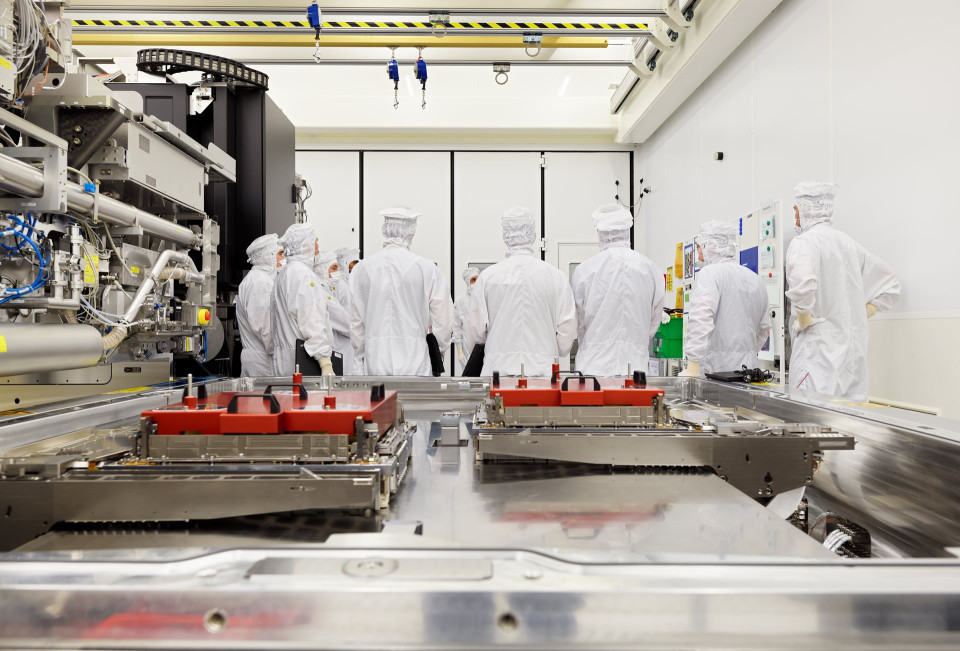
ASML Extreme ultraviolet lithography uses 13.5-nanometre light and exceptionally complex optics to pattern advanced chips. ASML’s eventual industrial success made it a critical chokepoint in the semiconductor chain because no alternative supplier produced comparable EUV systems at scale.
Sources & references 2 sources
-
Manufacturing
TSMC brings EUV chips into high-volume production
TSMC announced high-volume customer production using its N7+ process, an early commercial deployment of EUV.
The milestone showed that EUV had moved beyond laboratory promise into commercial manufacturing. Advanced nodes improved density and power efficiency, but node names are marketing labels and are not directly comparable across manufacturers.
Sources & references 1 source
-
Product Launch
Nvidia Hopper targets the era of giant AI models
Nvidia introduced the Hopper architecture and H100 accelerator for large-scale AI training and inference.
H100 combined specialised tensor processing, high-bandwidth memory and fast interconnects for data-centre systems. Demand during the generative-AI boom demonstrated that the strategic unit was becoming the complete accelerated-computing platform rather than an isolated processor.
Sources & references 1 source
-
Policy
The United States funds domestic semiconductor capacity
The CHIPS and Science Act committed major incentives to semiconductor manufacturing and research in the United States.
The programme reflected concern that leading-edge production was geographically concentrated and vulnerable to disruption. Subsidies can attract factories, but building a resilient supply chain also requires equipment, materials, skilled workers and years of process learning.
Sources & references 1 source
-
Geopolitics
Advanced AI chips become instruments of export control
The United States imposed broad controls on advanced computing chips and semiconductor-manufacturing equipment destined for China.
The rules explicitly linked high-end computing to national security and military modernisation. Later revisions adjusted thresholds and closed loopholes. The measures also showed the difficulty of controlling a supply chain distributed across U.S. design tools, Dutch equipment and Asian manufacturing.
-
Product Launch
Blackwell turns the AI accelerator into a rack-scale system
Nvidia introduced Blackwell GPUs and tightly connected systems designed for training and serving larger generative models.
Blackwell emphasised high-speed links, large memory pools and complete rack-scale infrastructure. Competitors including AMD, Google, Amazon and Microsoft accelerated alternative processors, but success increasingly depended on software, networking and supply commitments as much as raw silicon.
Sources & references 1 source
What comes next?
AI computing has become a geopolitical system as much as a technical market. Leadership requires software ecosystems, chip architecture, high-bandwidth memory, packaging, foundry capacity, lithography and reliable energy. Export restrictions and subsidies may reshape where capacity is built, but they cannot quickly recreate decades of specialised expertise. The race will increasingly be measured by complete systems and access to production, not transistor counts alone.